
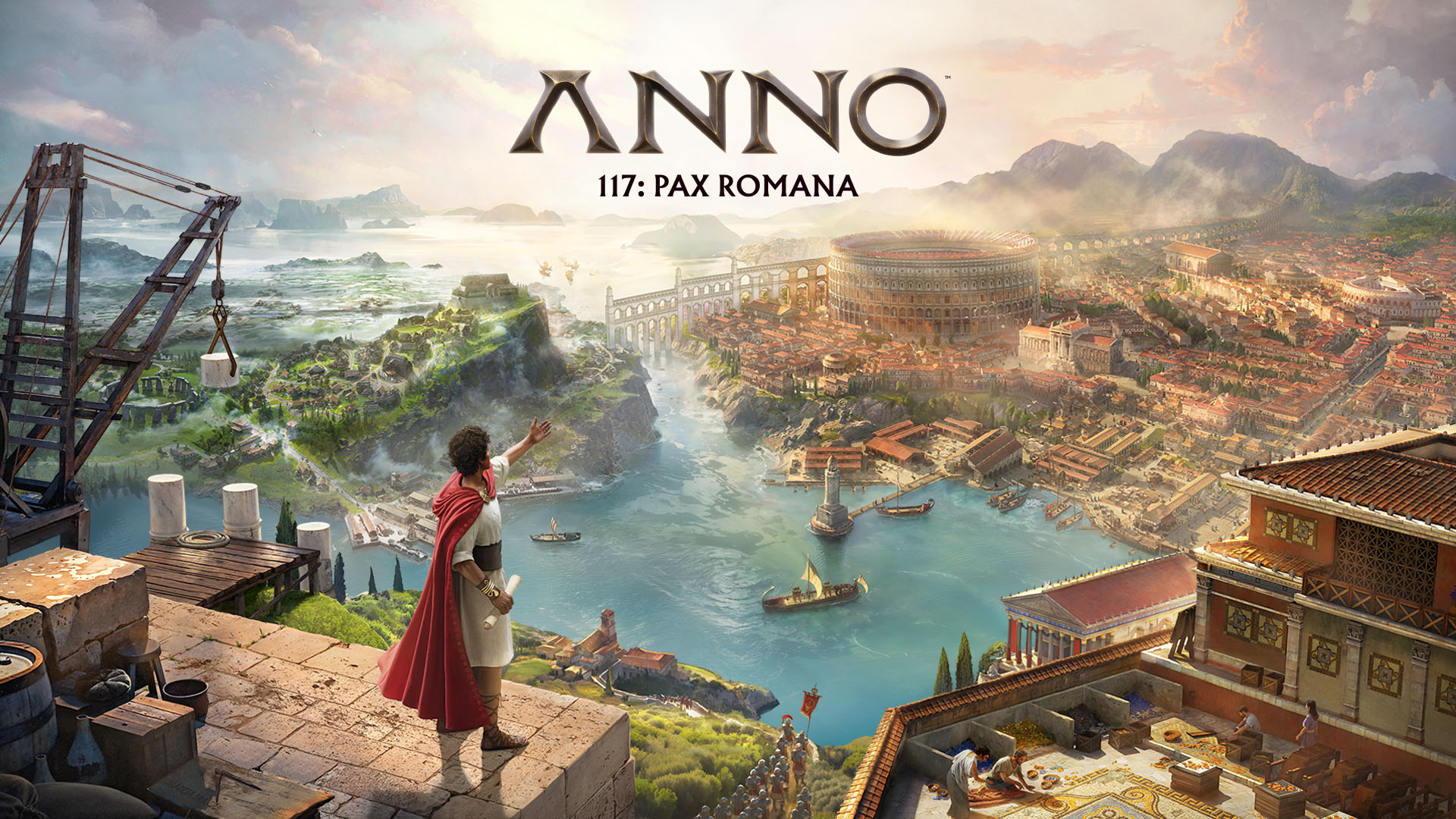
Can it really be that the (literally) ground-breaking building video game franchise Anno had yet to tackle the Roman empire? It feels such a natural fit for their brand. Players thought so, too, and let Ubisoft Mainz know it, and they listened. Anno 117: Pax Romana is a fully realized gift to gamers from the studio, it’s out now, and it was so worth waiting for. Intel Gaming Access put on their best togas and stolas and rolled out the imperial purple carpet for Aaron Scherzinger, who took time out from his job as senior 3D programmer at Ubisoft Mainz to build the buzz for this fantastic addition to the franchise. We, who are about to game, salute you!
The Roman Empire has always been associated with building—a staggering 55,000 miles of paved roads across Europe for starters—but also war. So why was Pax Romana the smart choice for this game? Aaron explains: “‘Pax Romana’ [was] a time of relative peace at the height of the Roman empire; the game combines the proven Anno formula consisting of grand city-building, deep economic simulation, and exciting 4X features like exploration and expansion. It portrays a different side of the story that has not yet been told, focusing on the multicultural aspect.”

This is fertile Anno ground; where cultures meet, and where trade is essential but fraught. “The game goes beyond classic city-building,” Aaron continues, “as players build complex trade networks, diplomatic alliances and sometimes even peace. The game lets players enjoy—as a Roman governor—the azure-blue waters and the warmth of the Tuscan sun in Latium, the province inspired by Italy. The landscapes are full of lavender fields and olive trees, offering enough building space for majestic metropolises and grand monuments to immerse players in the Roman fantasy. Players can also dive into the mysterious province of Albion—wet and misty, with thick fog covering lush forests and marshes; a new biome that you need to adjust your strategy to. They decide whether they want to embrace local tradition or Roman ambition. And as the world will react to their choices, the cost of peace is theirs to decide.”
Aaron uses the word fantasy, and though this edition of the series is grounded in history, it allows players to go beyond what is known. “Internal historians and team members with academic backgrounds in ancient history helped ensure that even in places where we added the classic Anno ‘twist’, the game mechanics still felt true to the spirit of the era. Players can look forward to experiencing the Roman empire as they’ve never seen it before. [Other] features include a modular ship system that has been inspired by real Roman vessels, a discovery tree that lets people research new mechanics based on their strategic approach, and a new Religion system.”

For those who have yet to break ground with Anno, what do they need to know? Aaron explains: “With improved onboarding and tutorials, Anno 117: Pax Romana welcomes both newcomers and veterans alike, ensuring that every player can enjoy the premier builder experience.” What will those veterans notice, alongside a new environment? “Visually, one of the features that are a bit under the radar is the GPU-driven procedural grass generation we implemented,” Aaron says. “The grass creates more dynamic and lively environments and is one of the new features (together with things like the terrain displacement mapping, the atmospheric scattering and the volumetric clouds and fog) that helped us shape the overall look of the game.”
With the increase in complexity and the number of objects in the game—greater than even its sophisticated predecessor Anno 1800—players might assume this edition would be CPU-heavy. But Ubisoft Mainz were ready for this challenge. “[Overcoming this] took a lot of effort,” Aaron says, “but it paid off in the end. Besides better CPU multithreading on the engine side, a key improvement was to move work from the CPU to the GPU. Due to the number of simultaneously running animations in a game like Anno, transitioning from CPU to GPU skinning was a big performance improvement.” Anno has always put players in the driving seat; they decide how their cities look and how their buildings adapt to the terrain, so the game can look very different to different players. “This prevents us from precomputing any lighting information,” Aaron affirms. “Thanks to support for hardware-accelerated ray-tracing in modern GPUs, we have a way to solve this.”

Long a PC-exclusive, Anno 117: Pax Romana marks the first time an Anno game releases simultaneously for PC and consoles, though Aaron recognizes Anno’s core community is PC-based. “Naturally, PC performance is very important to us,” he says, “and we did a lot of work to make the game runs well on a wide range of hardware configurations. For us, the best way to experience the game is with a graphics card that supports hardware-accelerated ray-tracing. We also support upscaling technologies like Intel® Xe Super Sampling (XeSS) to provide more scalability across a wide range of hardware.”
XeSS isn’t the only Intel tool that came in handy, particularly with that CPU issue. “One of the tools that was very helpful during development was the Intel® VTuneTM Profiler,” Aaron says. “It gave us a lot of insights and helped us to quickly identify some performance-critical code paths with a high number of cache misses. During later stages of development, we were in contact with Intel engineers who supported us by looking into specific issues and provided more insights.”
With the hard work of building the game behind them, Ubisoft Mainz now invites gamers to begin their build. But that’s not all—Anno 117: Pax Romana Year One Pass is coming in 2026, and it includes the chance to build the grandest monument in Anno’s history (inspired by the famous Circus Maximus). Better get your chariots off their blocks.
Purchase Anno 117: Pax Romana on Steam




 English (United States)
  Spanish (Argentina)
  English (Australia/New Zealand)
  German (Austria)
  Portuguese
  English (Canada)
  Spanish (Chile)
  Chinese (China)
  Spanish (Colombia)
  English (Denmark)
  Arabic (Egypt)
  English (Finland)
  French
  German
  English (India)
  Indonesian
  Japanese
  Malay
Malay  Spanish (Mexico)
  English (Netherlands)
  English (Norway)
  Spanish (Peru)
  Tagalog (Philippines)
  Polish
  Arabic
  Korean
  Spanish (Spain)
  English (Sweden)
  English (Switzerland)
  Chinese (Taiwan)
  Thai
Thai  Turkish
  English (UK)
  Vietnamese
  Italian