
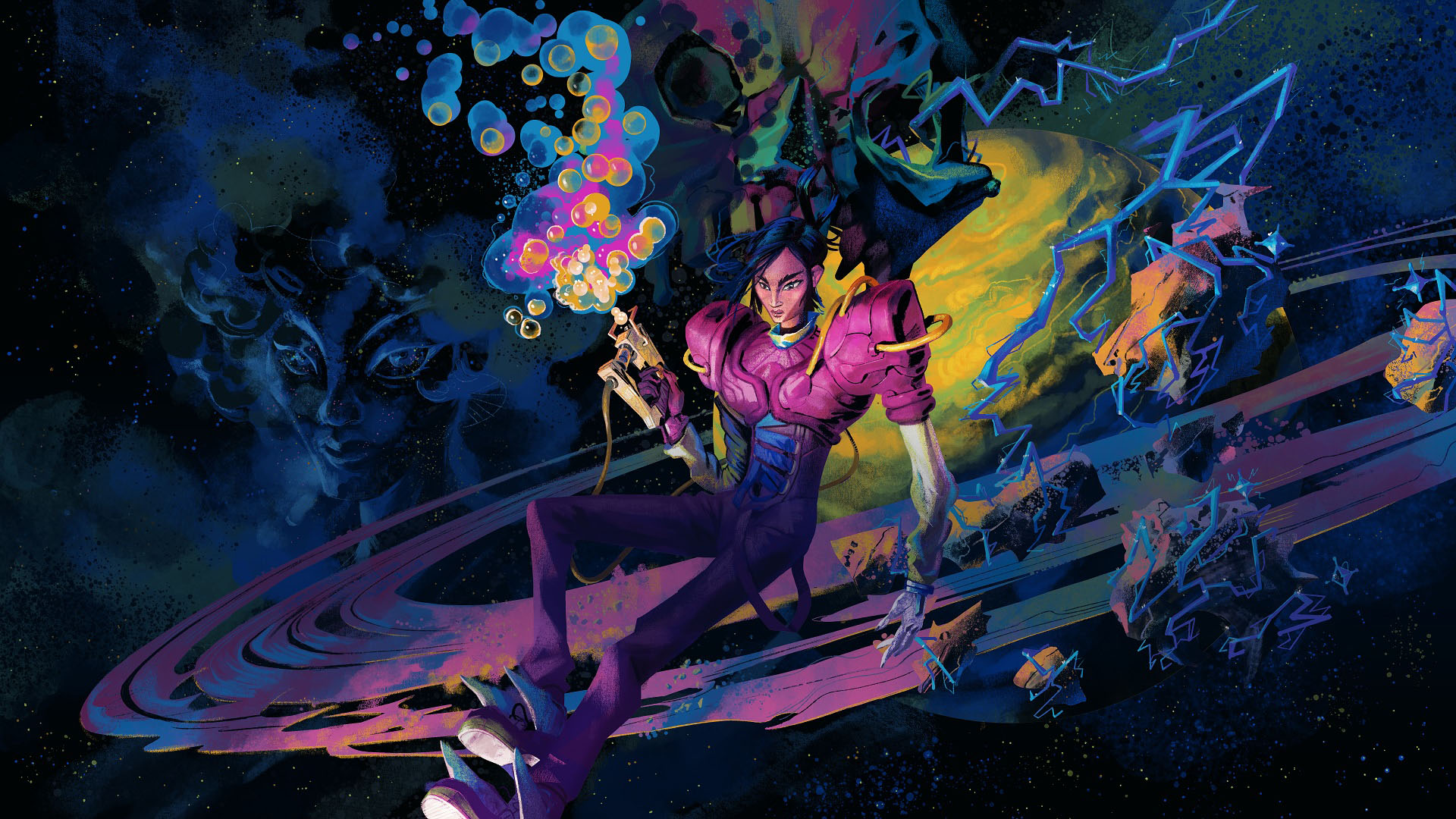
To any mycologists out there—maybe taking a rest after The Last of Us —a heads up. Ambrosia Sky is coming, and the fungus fear is back.
The debut game from AAA veteran-run studio Soft Rains lands on November 10th. It’s a deeply immersive sim about a fungal contamination that consumes an asteroid colony, leaving strangely beautiful devastation in its wake. You play as a mortuary scientist sent to collect samples—and the haunting stories of the dead. Narrative director Kaitlin Tremblay, studio head and creative director Joel Burgess, and technology director Jules Glegg took a spacewalk to Intel Gaming Access to share more about this fantastic voyage.
Space exploration is back on the global agenda, and Soft Rains are right in the thick of it. “We wanted to tell a sci-fi story that felt contemporary and was looking at what we are currently facing with space exploration,” Tremblay says. “We were inspired by Annihilation, as well as Arkane’s Prey, and others. Ambrosia Sky is for fans of exploration games or immersive sims, games with fun systemic interactions, for players looking for novel mechanics, as well as players interested in interactive storytelling and worldbuilding.”

The scenario might have you reaching for a flame thrower, but, as Tremblay explains, this is a very different kind of confrontation. “The gameplay blends rewarding exploration with meditative cleaning,” she says. “Use your chemical sprayer to cleanse unique strains of deadly fungi, each one trying to burn, electrocute, or trap you. Study their behaviours to craft powerful upgrades, like electrical foam you can use to reroute power. Ambrosia Sky isn’t just meditative. There are different mission types, some which emphasize more action-oriented gameplay. We’ve also built our own gravity technology—players can toggle between normal gravity and zero-g. The combination of systems in our games really give players room to play how they want to play.”
A threat that lives, breathes, and spreads all around you gives gamers a multi-layered challenge, and the developers food for thought. “The alien fungi of Ambrosia Sky blur the line between environment and enemy,” says Joel Burgess. “A lot of our development efforts have focused on how we create and interact with fungal colonies and their mushrooms. Once we’ve built a level in Unreal Engine 5, we’re able to place ‘seeds’ of specific fungal species within the space. Then, with the help of Houdini, a tool created by SideFX, we generate a network of nodes that search and procedurally adhere to the environment, from which we create the fungal colonies that players interact with.”
Interact with, but not make friends with. You are there to scour the blight away . “We really wanted the act of cleaning fungus to be super satisfying,” Joel adds, “and a big part of that for us was how the fungus gets destroyed. To support the super stylized art direction of Ambrosia Sky we built specialized tech, that we’ve been calling Quantized Impact Field, or QIF (pronounced ‘kiff’). QIF allows players to clean the fungus with great precision, even allowing you to burrow a tunnel through larger colonies.”

This world grows fast, and it grows more and more deadly; performance must keep up. “In Ambrosia Sky, you’re always at risk of encountering runaway fungal growth that can engulf entire whole rooms in seconds, create fire hazards, and interfere with electrical circuits or gravity,” Jules Glegg explains. “We’ve taken every opportunity to push the boundaries for these encounters, to make them really big and dramatic while keeping them super responsive and interactive. We invest hard in optimizing the game for a variety of hardware realities.”
Optimization is where Intel comes in, and we’re always thrilled to be along for the ride. “This is the first time we’ve teamed up with Intel,” Tremblay says, “and it’s been amazing to see how quickly our team was able to integrate Intel Xe Super Sampling (XeSS) and see its impact on the game, so we are excited about the collaboration!” We’re excited, too, of course, not only to optimize performance but also to support innovation. “For Ambrosia Sky, we created a totally new volumetric destruction technology,” Glegg reveals. “This technology is really reliant on GPU-accelerated animations. We really think this gameplay looks and feels the best when played with XeSS 2’s Super Resolution, and we really value that XeSS 2 is compatible with a broad range of graphics cards so we can deliver that experience to players everywhere from handheld devices to beefy desktop rigs.”

So wherever you land on that scale, you’re covered; and this is only act one for Soft Rains. “We’re incredibly excited to get players’ reaction to this opening chapter of the story,” Tremblay says, “and incorporate that feedback into Ambrosia Sky as we develop Act Two.” Meanwhile, there’s only a few more weeks to wait until the outbreak of Act One in the gaming universe: get ready, fungus-hunters.
Pre-purchase Ambrosia Sky at Epic Games Store or on Steam










 English (United States)
  Spanish (Argentina)
  English (Australia/New Zealand)
  German (Austria)
  Portuguese
  English (Canada)
  Spanish (Chile)
  Chinese (China)
  Spanish (Colombia)
  English (Denmark)
  Arabic (Egypt)
  English (Finland)
  French
  German
  English (India)
  Indonesian
  Japanese
  Malay
Malay  Spanish (Mexico)
  English (Netherlands)
  English (Norway)
  Spanish (Peru)
  Tagalog (Philippines)
  Polish
  Arabic
  Korean
  Spanish (Spain)
  English (Sweden)
  English (Switzerland)
  Chinese (Taiwan)
  Thai
Thai  Turkish
  English (UK)
  Vietnamese
  Italian