
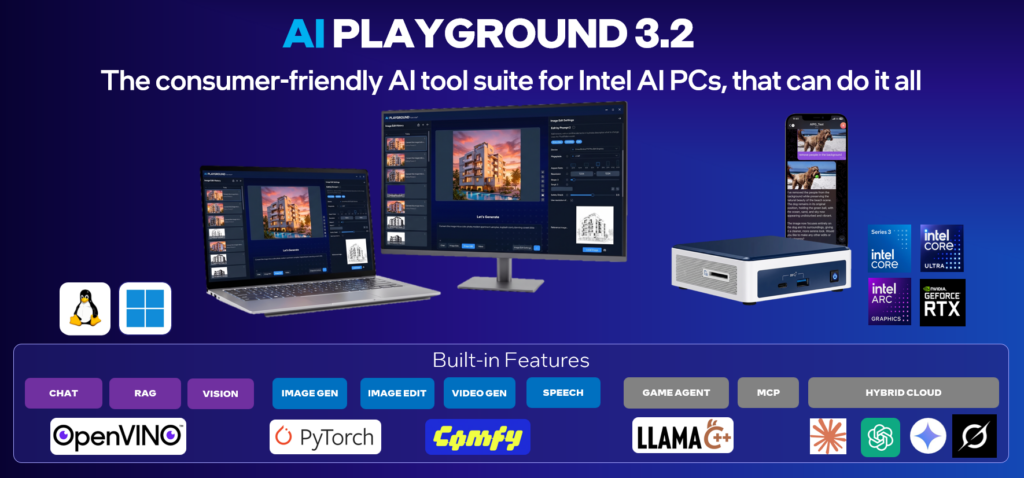
Over the last few months, AI Playground has gone through a significant evolution. Its focus remains as a comprehensive consumer-friendly Gen AI app for Intel AI PCs. What’s changing is the future of AI on PCs, especially with agents. This summer we’ve laid the groundwork to show how the Intel AI PC can be the defining hardware platform for consumer AI in an agentic AI future, delivering utility, flexibility, and control directly to the edge. And for our internal teams and external partners, this summer has been an incredible run of rapid execution. Below are updates for the 3.1.2 (June) and 3.2.0 (August) releases.
Opening Up the Playground (June Release)
We kicked off the summer with an aggressive goal: transition AI Playground from a robust desktop app to a forward-leaning personal AI hub for multiple markets. By shipping these new features, we directly expand the consumer value proposition of Intel hardware. Here are highlights from version 3.1.2.
1. Home Agent: Extending the Reach of the AI PC
What good is having a high-performance Intel AI PC at home if you can’t leverage it while on the go, as easily and as conveniently as a cloud service? Home Agent solves this by allowing users to remotely access their AI Playground host via Slack or Telegram apps on their smartphone. Your PC, while sitting at home, does the heavy lifting, and the results are sent straight to your mobile screen. This shows consumers that their AI PC can be an always-on, remote resource, not just a desk-bound processor or piece of hardware they must lug around with them.
See Home Agent in action
2. Linux Support: Cross-Org Synergy in Action
This major milestone began as a pull request (PR) contribution from another team supporting a target vertical which needed a secure, robust Linux implementation of AI Playground. We seized that momentum, validated their contribution for standard Ubuntu, and unlocked AI Playground for a fast-moving, AI-adopting consumer base. From installation, client experience, backends and model support, all of AI Playground now runs on Linux. This is a prime example of how internal Intel collaborations are directly enriching our consumer software stack.
3. Chat to Speech: Unleashing the NPU
With this feature, we’ve given AI Playground a high-fidelity voice with support across many languages and vocal types allowing you to both speak to, and now listen to AI Playground, even remotely via your Telegram app. When the app generates a speech response, it defaults to the NPU (Neural Processing Unit). By offloading this pipeline to our dedicated low-power AI silicon, we keep the CPU and GPU completely free to handle concurrent system tasks. Paired with our Speech-to-Prompt features, this creates an incredibly smooth, fully local voice loop that showcases the architectural strength of Intel’s multi-engine platform.
4. Built-in Tools: Web Search & Screen Capture (via MCP)
As we integrated more capabilities into other apps and tools, we’ve added native web search and screen capture to assist models through multiple tasks. This allows local models running on Intel silicon the option to pull real-time data from the web and/or visually analyze active application windows running through MCP. This turns a static LLM into an active, context-aware assistant.
Elevating the Platform (August Release)
With the early summer foundation in place, our late-summer roadmap shifted toward deeper platform refinement, ecosystem partnerships, and bringing cutting-edge autonomous agentic workflows to the edge. Look for these features in AI Playground 3.2.0.
5. Context Compression: Maximizing the Edge Window
As users prompt heavier workloads through Home Agent, Code Assist, and MCP, context limits can become a bottleneck. Context Compression solves this by dynamically refactoring conversation history. This allows for significantly longer, multi-turn interactions without running out of context – massively improving usability on consumer hardware.
6. Hybrid Cloud Support: TCO and Privacy on Your Terms
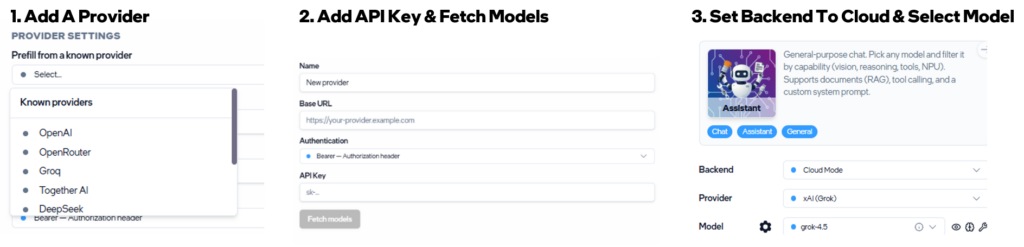
The strength of local AI is privacy, low-latency, and zero subscription fees. But sometimes, a task demands a massive, multi-hundred-billion-parameter model. Hybrid Cloud Support gives users the best of both worlds. They can run everyday workloads locally on their Intel AI PC and seamlessly route massive, complex queries to cloud-based frontier models. It’s a pragmatic, cost-effective hybrid strategy that keeps the consumer in control of their data. It gives you the flexibility to balance local privacy against cloud-scale power. Simply add your favorite provider then choose when you want to stay local or use frontier models from the cloud.
7. Game Agent
The future of AI is agentic, and we are leading the charge with our first autonomous agentic tool: Game Agent. This agent goes beyond basic code generation. It helps users design, build, and debug complete video games and web apps – autonomously organizing assets, taking screenshots, writing descriptions, and creating icons.
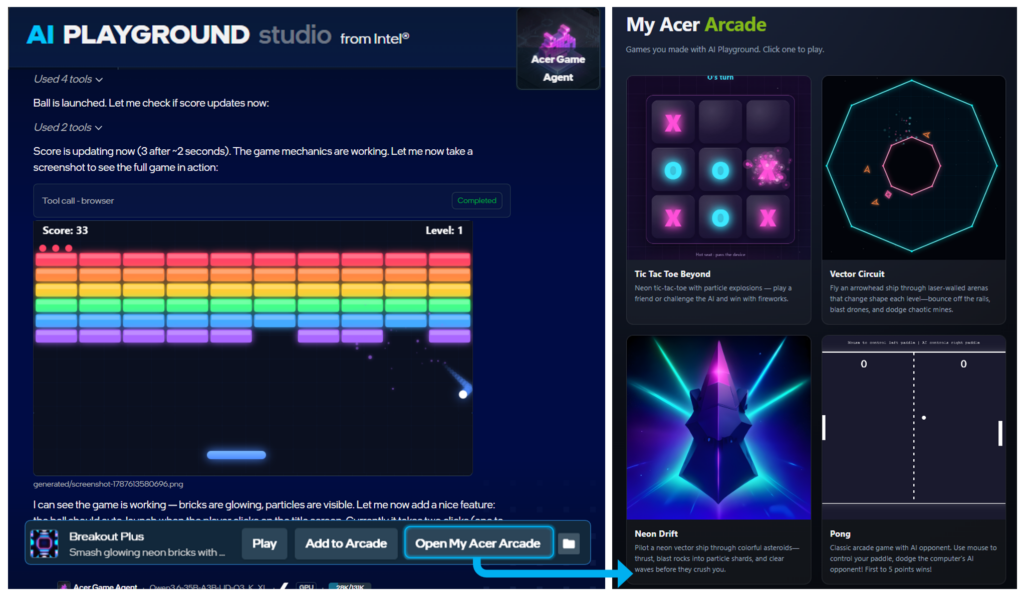
Game Agent not only showcases the raw multi-tasking power of Intel processors, but also paves the way for a highly customizable agentic harness that our OEM partners can leverage. Acer has partnered with Intel to support a differentiated experience for its customers. Expect some surprise features exclusive to Acer using Game Agent.
8. Improving the Experience
Speech Gen: Media creation is a massive differentiator for our platform. We’ve taken that to the next step with the Qwen Text-to-Speech (TTS) family of models, allowing users to generate high-quality voiceover files and audio assets directly inside AI Playground. Take a listen to Speech Gen.
Private (LAN) Home Agent: While Home Agent via Slack or Telegram is incredibly convenient, highly regulated environments require total privacy. Once again, our vertical teams have driven requirements to advance AI Playground. This feature allows users to remote-control AI Playground from a wireless or tethered local network device, entirely offline, with zero external cloud dependencies. This represents a win for secure, local-first AI computing.
OMIX for Linux: Standardizing Platform Stability: To address environmental and driver fragmentation across various Linux distros, we have aligned our installation guidelines with Intel Open Middleware (OMIX). By providing a stable, unified environment that aligns graphics drivers and Level Zero dependencies with upstream frameworks, we are ensuring a robust out-of-the-box developer experience on Intel silicon.
Driving the Ecosystem Forward
It’s been a busy and exciting summer that has shown us what’s possible when Intel software engineering, internal business units, and external OEM partners pull in the same direction. By delivering agentic capabilities, offline security, and optimized NPU and GPU pipelines, we are proving that the Intel AI PC is not just a hardware spec – it’s an open, thriving ecosystem built for real-world execution. Let’s keep building.